

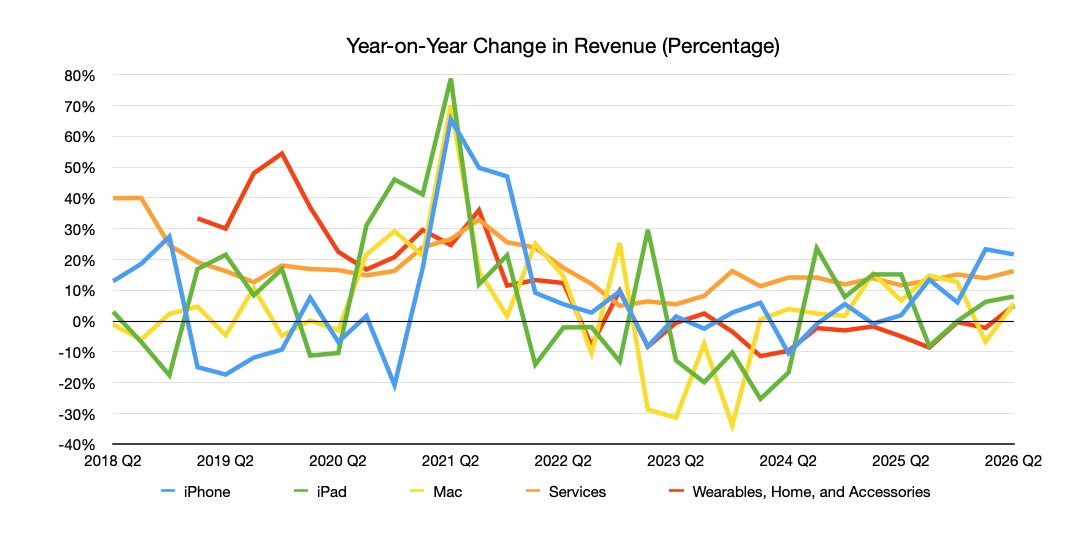
 Apple’s hardware revenue remains cyclical, while Services growth has become a more stabilizing force for investors.
Apple shares closed above $300 for the first time after investors rewarded the company’s stronger-than-expected earnings, surging Services revenue, and massive $100 billion buyback despite continued criticism of its delayed AI rollout.
Apple shares closed at a new record high of $300.23 on May 15, surpassing both the $300 mark and the company’s previous closing record of $287.51 set on May 6. Earlier in 2026, investors worried about delayed Siri features, slowing hardware growth, tariff exposure, and growing competition in generative AI.
Apple stock briefly reached a 52-week high during the trading day of $303.20.
The rally accelerated after Apple reported $111.2 billion in revenue and earnings per share of $2.01 for the quarter ending March 28, both above Wall Street expectations. The company also approved another $100 billion stock buyback and raised its quarterly dividend to $0.27 per share.
Apple generated more than $28 billion in operating cash flow during the quarter, reinforcing investor confidence in the company’s core business. Tim Cook said demand for iPhone remained strong during the March quarter, while Services revenue reached another all-time high.
Greater China revenue jumped roughly 28% year over year after several weaker quarters. The rebound helped calm investor concerns that Apple was losing ground in one of its largest markets.
Investor confidence in Apple continues to surge, driven by several compelling factors that have reinforced the company’s standing in the marketplace. At the heart of this optimism lies Apple’s consistent delivery of robust financial results, underscoring its ability to navigate the complexities of the global tech landscape. The company’s strategic approach to maintaining a diversified product lineup has been a crucial driver, ensuring that it remains resilient in the face of evolving consumer preferences and market demands.
Foremost among these factors is the remarkable performance across Apple’s product lines, notably within the Services segment. The rapid expansion of Apple Music, iCloud, and the App Store has fortified Apple’s revenue streams, providing a steady and rising flow of income that is less susceptible to the cyclical nature of hardware sales. This shift towards services has not only balanced Apple’s portfolio but also promised investors a more stable financial future.
Moreover, Apple’s strategic investments continue to instill confidence among stakeholders. By channeling resources into emerging fields such as augmented reality (AR) and health technology, Apple demonstrates a forward-looking vision that aligns well with current technological advancements. These investments are seen as long-term plays, expected to sow the seeds of future growth and expand Apple’s competitive edge in new and exciting markets.
Despite the backdrop of economic uncertainties and AI-related challenges, Apple’s strong global presence and significant market share act as a formidable buffer. The company’s commitment to privacy and ethical technology further bolster investor sentiment, helping mitigate fears associated with the rapid evolution of AI. Apple’s ability to thrive amidst regulatory scrutiny and competitive pressure exemplifies its resilience and strategic prowess.
The confidence stemming from these foundational elements allows investors to overlook short-term challenges, focusing instead on Apple’s potential to deliver sustained growth and profitability. As Apple continues to enhance its core capabilities and explore new frontiers, the market’s faith in the company’s vision remains unshaken, reinforcing its leadership in the tech world.
In the evolving landscape of technology, the impressive role that Services revenue plays in Apple’s financial success cannot be understated. At the core of this robust performance lies Apple’s ability to pivot smoothly from its traditional hardware focus to a more diversified revenue model that capitalizes on digital ecosystems.
The Services segment has emerged as a powerhouse for growth, with offerings such as Apple Music, iCloud storage, and the App Store driving consistent revenue increases. Unlike hardware sales, which can fluctuate with product cycles and consumer demand, services provide a recurring revenue stream that boosts financial stability and reassures investors.
- Apple Music: This streaming service has continually expanded its user base, competing effectively against well-established players in the market.
- iCloud: With the ever-growing need for cloud storage, iCloud has become indispensable for many users, generating steady subscription income.
- App Store: As the gateway to iOS apps, the App Store not only supports developers but also generates substantial commissions on app sales and in-app purchases.
Moreover, Apple’s commitment to innovation within its service offerings has led to the integration of advanced technologies such as machine learning and artificial intelligence, enhancing user experiences and fostering deeper engagement. This strategic expansion has solidified customer loyalty, which in turn strengthens Apple’s brand ecosystem.
For investors, Apple’s Service revenue represents not just a shift in strategy but a testament to the company’s foresight in adapting to digital transformation trends. As global digital consumption accelerates, Apple is well-positioned to capitalize on the evolving market demands, underscoring its resilience and long-term growth potential. This strategic transition provides a buffer against hardware cyclicality, proving Apple’s capability to thrive in a rapidly changing tech environment.
Navigating the landscape of artificial intelligence has become one of the central challenges Apple faces as it continues to secure its position as a global tech leader. While AI presents exciting opportunities for innovation and growth, it also brings along its fair share of criticisms and concerns. For many stakeholders, balancing an optimistic outlook with a mindful consideration of AI risks is crucial.
Investors and consumers alike have voiced worries about Apple’s pace in integrating AI compared to its competitors. With tech giants like Google, Microsoft, and Samsung advancing rapidly in the AI arena, pressure mounts for Apple to showcase its capabilities. Despite this, Apple has been strategically deliberate in its approach, focusing on building a solid and secure foundation for its AI technologies.
One of the primary criticisms directed at Apple is the delay in releasing comprehensive AI features, like the much-anticipated enhancements to Siri. In response, Apple underscores its commitment to privacy and ethical AI development, emphasizing that the responsible implementation of AI takes precedence over rushing to market. This stance may teint fast progress, but it roots Apple’s innovations in trust and security.
More than just a matter of public relations, Apple’s logo is entwined with reliability and user-centric policies, which contributes to alleviating many of the criticisms it faces. The company is actively investing in AI research focused on user experience enhancements while maintaining user privacy – a crucial point that separates it from rivals. By investing in AI projects that are aligned with its broader business strategy and ethical standards, Apple is building AI technologies that promise to be transformative yet safe.
As AI technology evolves, Apple remains focused on sustainable growth and maintaining its reputation for quality. Investors who understand and appreciate this approach continue to support the company, banking on its long-term vision rather than immediate AI advancements. In this way, Apple aims to lead with caution, ensuring its AI journey enhances its ecosystem cohesively without compromising its foundational values.
As Apple navigates the future, the company’s strategic outlook signals a promising trajectory, rooted in innovation and adaptability. Investors can take comfort in Apple’s expansive strategic roadmap, which balances immediate needs with long-term objectives. This balance ensures that Apple remains at the forefront of technology while maintaining the resilience necessary to weather industry shifts.
One of the key components of Apple’s future prospects is its continued investment in research and development. The company has earmarked significant resources to unravel new possibilities in artificial intelligence, augmented reality, and other cutting-edge technologies. By prioritizing innovation, Apple seeks to enhance its product offerings and create groundbreaking solutions that seamlessly integrate into users’ lives.
Apple’s focus on environmental sustainability also forms an essential aspect of its strategic outlook. The corporation has set ambitious goals to become carbon neutral across its entire business, manufacturing supply chain, and product life cycle by 2030. This commitment not only demonstrates Apple’s dedication to corporate social responsibility but also aligns with the growing consumer demand for environmentally conscious practices.
The expansion of Apple’s services ecosystem plays a crucial role in its forward-looking strategy. By strengthening services like Apple TV+, Apple Arcade, and the Fitness+ platform, the company broadens its revenue base beyond its hardware products. These services enrich the Apple ecosystem, enhancing user engagement and fostering a sense of community among its vast customer base.
Furthermore, Apple’s strategic global outreach, including its expansion in emerging markets, positions the company to capture new growth opportunities. By tailoring products and services to meet the unique needs of different international regions, Apple continues to increase its footprint and brand influence worldwide.
Investors, analysts, and consumers can draw confidence from Apple’s commitment to a robust strategic outlook. By focusing on innovation, sustainability, and global expansion, Apple remains steadfast in its pursuit of excellence. This dedicated approach ensures that Apple not only remains a leader in the tech industry but also sets the standard for ethical and sustainable business practices. For related coverage, see our Musk takes on tech giants in landmark lawsuit.
